How to Calculate Etsy Profit Before Pricing a Product
Pricing an Etsy product can feel like a guessing game.
You look at similar listings, check what other sellers charge, think about your time, wonder if the price is too high, then worry it may be too low.
But a product price should not come only from guessing.
Before choosing a price, it helps to understand your costs, possible Etsy fees, shipping costs, payment processing, advertising, time, and the profit you actually want to keep.
This guide explains a simple way to think about Etsy profit before pricing a product.
It is not financial, accounting, tax, or legal advice. Etsy fees and rules can change, and some fees depend on your country, currency, payment setup, advertising settings, and type of sale. Etsy’s official Fees & Payments Policy explains that sellers may be charged listing, transaction, payment processing, advertising, and other applicable fees, so always check Etsy’s current official information before finalizing your prices.
What is Etsy profit?
Etsy profit is the amount left after you subtract the costs connected to making, listing, selling, delivering, and running your product.
A simple version looks like this:
Sale price - product costs - Etsy fees - payment processing - shipping costs - other expenses = estimated profit
For digital products, shipping may not apply, but you may still have design tools, software, mockups, fonts, listing fees, advertising costs, transaction fees, payment processing fees, and the time spent creating the product.
For physical products, you may also have materials, packaging, labels, shipping supplies, printing, storage, damaged items, and replacement costs.
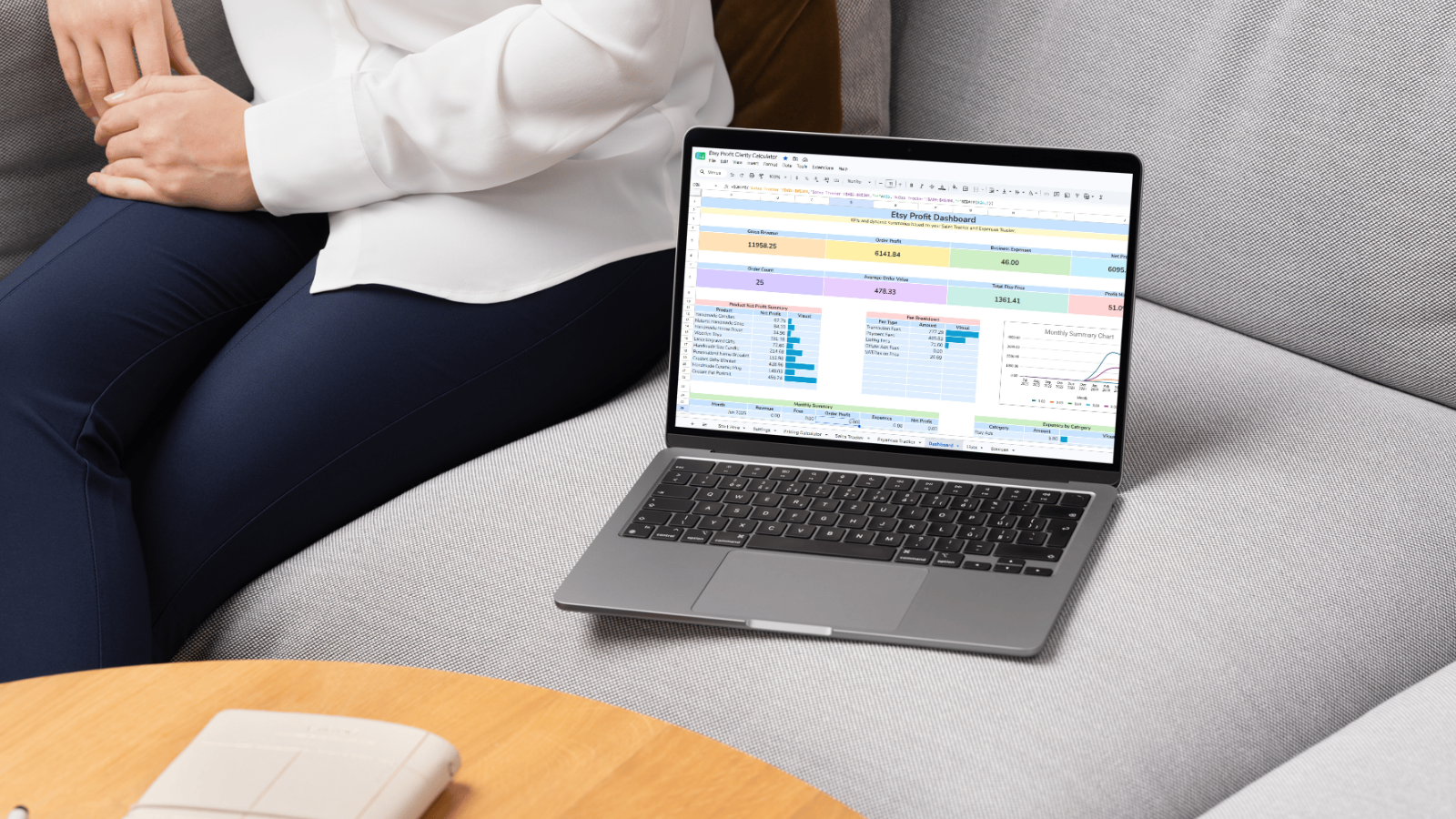
If you want a ready-made tool for this type of planning, you can browse Etsy Seller Tools. If you need more general business tracking, visit Small Business Tools.
Why Etsy pricing is easy to get wrong
Many sellers start by checking competitors.
That can help you understand the market, but it does not tell you whether your own price is profitable.
Two products may look similar but have different costs behind them. One seller may use cheaper materials. Another may have a different fee structure, lower ad costs, higher order volume, or a completely different business goal.
A low competitor price does not automatically mean your product should be low too.
A high competitor price does not automatically mean your product can support the same price either.
You need your own numbers.
Start with the sale price
The sale price is the amount the buyer sees for the product before any discounts, taxes, shipping, or other order details.
For digital products, this may be the price of a printable planner, spreadsheet, invitation template, wall art file, or digital download.
For physical products, it may be the item price before shipping.
Your sale price is the starting point, but it is not your profit.
A $10 product does not mean you made $10.
The real question is: what remains after costs and fees?
Add your product costs
Product costs are the costs directly connected to creating or delivering the product.
For physical products, these may include:
- raw materials
- packaging
- labels
- printing
- shipping supplies
- product inserts
- damaged or wasted materials
- replacement items
- production tools
For digital products, these may include:
- design software
- spreadsheet tools
- mockup images
- fonts or graphics
- Canva Pro or other design subscriptions
- stock elements
- file hosting tools
- testing prints
- instruction PDFs
- listing images
Digital products may look “free” to deliver, but they are not free to create. Your tools, time, testing, product images, and updates still matter.
Include Etsy fees
Etsy fees are one of the main reasons sellers need to calculate profit before choosing a price.
Etsy’s official help pages describe a listing fee, and Etsy’s Fees & Payments Policy describes transaction fees and other possible fees. Etsy also states that payment processing fees vary by the location of the seller’s bank account. Because these details can change or depend on location, do not rely on old screenshots, old blog posts, or random calculators without checking Etsy’s current official fee pages.
Instead of memorizing one number forever, build your pricing process around this habit:
Check current Etsy fees, then update your pricing calculator or spreadsheet.
This is especially important if you sell from outside the United States, sell in a different currency, use Etsy Ads, receive orders through Offsite Ads, or pay payment processing fees in your country.
Do not forget payment processing
Payment processing is separate from the idea of “product cost.”
If the buyer pays through Etsy Payments, Etsy charges a payment processing fee, and Etsy says the amount varies by the location of the seller’s bank account.
This means sellers in different countries may not have the exact same payment processing cost.
If you are building an Etsy pricing spreadsheet, payment processing should be its own line, not hidden inside a vague “fees” number.
That makes it easier to update later if something changes.
Include shipping and packaging if you sell physical products
If you sell physical products, shipping can change your profit quickly.
Think about:
- postage
- packaging
- boxes
- envelopes
- tissue paper
- labels
- tape
- protective material
- printer ink
- failed labels
- replacement shipments
- shipping upgrades
- returns or damaged parcels
Even small packaging costs can matter if your product price is low.
If you offer free shipping, the cost is still there. It is simply included in your pricing structure instead of charged separately to the buyer.
Include discounts and coupons
Discounts can make a product look attractive, but they can also reduce profit.
Before running a sale, check how the discounted price affects your margin.
For example, if your regular price barely covers costs and fees, a discount may turn the sale into very little profit or even a loss.
This matters for:
- launch discounts
- seasonal sales
- coupon codes
- abandoned cart offers
- thank-you coupons
- bundle discounts
- repeat buyer discounts
A good Etsy pricing calculator should let you test both the regular price and the discounted price.
Include advertising costs
If you use Etsy Ads or Offsite Ads apply to an order, advertising can affect profit.
Ad costs are not always predictable at the individual product level, but they should still be part of how you think about pricing.
Ask yourself:
- Do I use Etsy Ads?
- Do I know how much I spend per month?
- Which products receive ad traffic?
- Can my product price survive advertising costs?
- Would the product still be profitable after a discount and ad cost?
For beginner sellers, it is easy to look only at sales and forget the cost of getting those sales.
Include your time
Time is one of the most ignored costs.
This is especially true for handmade products, custom products, editable invitations, personalized items, and digital products that take many hours to create.
Your time may include:
- product research
- design
- writing instructions
- testing files
- creating mockups
- taking photos
- writing listings
- answering messages
- making custom edits
- packaging orders
- updating files
- fixing mistakes
- customer support
You may not include your time in the same way for every product, especially when starting out. But you should at least be aware of it.
If a product takes ten hours to create and sells for a very low price, you need enough volume or long-term value to justify it.
Understand gross profit and net profit
Gross profit usually looks at sale price minus direct product costs.
Net profit goes further and considers more expenses.
For Etsy sellers, the practical version is:
Gross profit: sale price minus direct product costs.
Estimated net profit: sale price minus product costs, Etsy fees, payment processing, shipping, packaging, ads, discounts, and other business expenses.
Net profit is the number that tells a clearer story.
A product can have a good sale price and still have weak net profit.
Calculate profit margin
Profit margin helps you understand how much of the sale price you keep as profit.
A simple version is:
Profit ÷ sale price × 100 = profit margin percentage
For example, if a product sells for $20 and the estimated profit is $8, the profit margin is:
8 ÷ 20 × 100 = 40%
Profit margin helps you compare products with different prices.
A $5 profit on a small digital product and a $5 profit on a large handmade product may not mean the same thing if the time, cost, and effort are completely different.
Use a simple Etsy pricing formula
A simple pricing formula can look like this:
Product cost + fees + payment processing + shipping/packaging + advertising allowance + time allowance + desired profit = target price
This is not a perfect formula for every shop, but it gives you a better starting point than guessing.
For digital products, you may use:
Tool costs + listing/marketplace costs + payment processing + advertising allowance + time/value + desired profit = target price
For physical products, you may use:
Materials + packaging + shipping supplies + fees + payment processing + advertising allowance + time + desired profit = target price
Then compare your target price with the market.
If your calculated price is much higher than similar products, you may need to improve the product value, reduce costs, bundle items, change positioning, or accept that the product is not worth selling in that format.
Price is not only math
Math matters, but price is also about value.
A product can justify a higher price if it saves time, solves a clear problem, looks polished, includes instructions, is easy to use, has strong listing images, or feels more complete than cheaper alternatives.
This is especially true for digital products.
A spreadsheet that is accurate, clear, protected, beginner-friendly, and well explained can feel more valuable than a pretty but confusing file.
A printable planner that is easy to print and actually useful can feel more valuable than a decorative page that does not solve a real problem.
If you are building digital products for your own shop, this is why product quality and listing clarity matter so much.
Common Etsy pricing mistakes
One common mistake is pricing only by looking at competitors.
Another is forgetting fees.
Another is forgetting payment processing.
Another is forgetting packaging or shipping supplies.
Another is offering discounts without checking the final profit.
Another is treating digital products as if they have no cost.
Another is ignoring time.
Another is believing that sales automatically mean profit.
A busy shop is not always a profitable shop.
Pricing digital products on Etsy
Digital products can be powerful because one file can sell more than once.
But digital products also need upfront work.
You may spend time on:
- design
- research
- spreadsheet formulas
- testing
- proofreading
- instructions
- screenshots
- mockups
- listing images
- SEO
- customer support
- updates
Because delivery cost is low, sellers sometimes underprice digital products too much.
A low price may help early testing, but if the product took serious work and solves a real problem, it should not be priced only as a cheap file.
For Ayohi-style digital products, the value comes from usefulness, clarity, beginner-friendly structure, and trust.
Pricing handmade or physical products
Physical products often have more visible costs.
Materials, packaging, labels, and shipping supplies are easier to see than digital product costs.
But sellers still forget hidden costs.
For example, a handmade product may also include failed attempts, wasted materials, storage, tool wear, photo props, travel to buy supplies, or time spent packaging.
If your product is handmade, your time and skill are part of the product.
Do not calculate only the material cost.
Pricing invitations and editable templates
Editable invitations and event templates need a slightly different pricing mindset.
You may need to consider:
- design time
- editable template setup
- Canva or design software
- fonts and elements
- testing the template link
- instructions for the buyer
- customer questions
- possible customization requests
- matching items like RSVP cards or thank-you cards
If you sell event templates, you may also want to think about bundles.
A single invitation may sell at one price, but a matching invitation, RSVP card, welcome sign, and thank-you card may create a stronger product.
You can browse Ayohi’s event-focused category at Invitations & Events.
Pricing planners and spreadsheets
Planners and spreadsheets should not be priced only by how they look.
A planner may be valuable because it helps someone organize their week, home, budget, or child’s routine.
A spreadsheet may be valuable because it saves someone time, performs calculations, reduces confusion, and gives structure.
For example, a small business spreadsheet may help someone track income and expenses more clearly. An Etsy profit calculator may help a seller avoid pricing blindly. A monthly budget planner may help a family understand money better.
If the file is useful, tested, clear, and beginner-friendly, that has value.
You can browse related collections at Budget Planners, Printable Planners, and Small Business Tools.
When to use an Etsy profit calculator
Use an Etsy profit calculator when you want to test prices before publishing or updating a product.
A good calculator can help you compare:
- regular price
- discounted price
- product cost
- estimated fees
- payment processing
- shipping cost
- packaging cost
- ad allowance
- desired profit
- estimated profit margin
This helps you see how a small price change affects your profit.
It also helps you avoid setting prices only by emotion.
When to use an Etsy pricing spreadsheet
Use an Etsy pricing spreadsheet if you want to keep product pricing organized over time.
A spreadsheet can help you record multiple products, test different prices, update costs, compare profit margins, and keep notes about changes.
This is useful if you sell many listings, bundles, digital downloads, printables, invitations, handmade products, or seasonal items.
You can find Etsy-focused tools in Etsy Seller Tools.
A simple pricing routine before publishing
Before publishing a product, take a few minutes to check the numbers.
Write down the product price.
Add product costs.
Add estimated marketplace fees.
Add payment processing.
Add shipping and packaging if needed.
Add advertising or discount assumptions if they apply.
Think about your time.
Look at the estimated profit.
Then ask:
- Is this profit worth the work?
- Is this price realistic for the market?
- Can I improve the product value?
- Would a bundle make more sense?
- Would a higher price still feel fair?
- Would a discount make this unprofitable?
This routine can prevent many pricing mistakes.
Final thought
Pricing does not need to be perfect from the beginning.
But it should be intentional.
An Etsy seller should know why a product is priced the way it is. The price should consider costs, fees, time, value, and profit — not only what other sellers charge.
A simple pricing system can make your shop feel less confusing and more grounded.
If you want help organizing your Etsy prices, products, listings, and profit estimates, browse Etsy Seller Tools. For broader business tracking, visit Small Business Tools.
If you are new to digital templates, read How It Works or visit the FAQ. You can also try a simple sample from Free Templates or learn more about the story behind Ayohi on About Ayohi.